

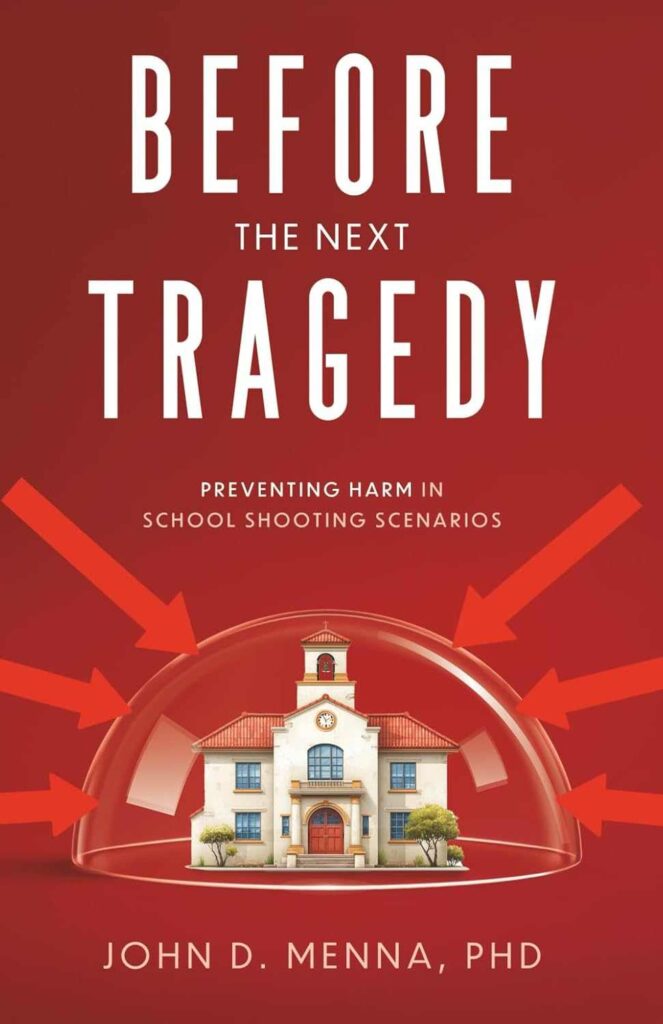
The following is a contributed post from John D. Menna, Ph.D., author of Before the Next Tragedy: Preventing Harm in School Shooting Scenarios.
If you’re anything like me, there are certain headlines that lodge themselves in your soul and never quite leave. The shooting at Marjory Stoneman Douglas High School in Parkland, Florida, on February 14, 2018 was one of those moments for me. That year, my daughter was entering high school in Knoxville, Tennessee.
My interest deepened as I followed the public town hall meetings and read numerous commission reports on shootings across the country, including the tragedies at Sandy Hook Elementary School in Newtown, Connecticut; Marjory Stoneman Douglas High School in Parkland, Florida; and Robb Elementary School in Uvalde, Texas. Although these may be the most widely recognized K–12 school shootings, the issue extends far beyond these tragedies. Since 1999, there have been more than 2,400 school shootings nationwide. Each new incident brings renewed sorrow and a collective call for more research in the domains of mental health and behavioral psychology, particularly regarding their connection to school violence.
Shifting Priorities When Prevention Fails
Identifying real threats and then disrupting them will always be the primary preventive measure for targeted school violence. When efforts fail to prevent a planned attack on a school, attention turns to determining how the firearms were obtained and renewing calls for stricter gun controls. Yet, if such attempts fail to stop an active shooter incident, the priority must shift from preventing threats to implementing effective physical safeguards to counter the attack. Protecting students and staff then relies entirely on the school’s ability to protect itself from harm.
This article draws on the high-reliability safety practices of high-hazard facility operations to strengthen K–12 school capabilities when efforts fail to foil premeditated attacks. It identifies areas in current methods where a deeper understanding of risks is necessary in designing safeguards to protect students and staff in active shooter scenarios. Framing preventing harm as the central purpose of protecting people, as opposed to the more arbitrary goal of minimizing consequences of assaults, represents a shift in school safety culture. Current guidance lacks this focus. Achieving this ultimate level of safety requires a more rigorous process to recognize hazards and develop effective protective measures or controls.
Inspiration from High-Hazard Safety Management
The concepts discussed in this article can be found in the book Before the Next Tragedy: Preventing Harm in School Shooting Scenarios, a work developed over nearly eight years following the Marjory Stoneman Douglas High School shooting. Drawing on more than 40 years safeguarding people and operations within the U.S. Department of Energy (DOE) nuclear defense complex, my experience has shaped an important and necessary perspective needed to gain a deeper understanding of the underlying risks to students and staff and then to formulate defenses to protect them from an unpredictable assailant.
More than 20,000 facilities have been built and operated under the DOE. Preventing debilitating injury to any worker or the public is a safety management imperative to gain federal approval to operate these facilities. Given the risk of serious injury or death at the hands of an active shooter, the same safety practices should apply to protect human life in these events.
This article highlights some of the important areas where school safety can be improved.
You might also like to read: Focus on Offering Emotional Safety During the Teen Years
Safety Fails When “Minimizing Harm” Becomes the Goal
School safety must be based on the belief that harm is preventable. Even when efforts fail to detect a plot to target a school, preventing harm is still achievable and must remain the goal.
The current guidance in many proposed security plans is to limit consequences of incidents that do occur as much as possible. However, limiting or minimizing casualties, while often considered an acceptable outcome, diminishes safety. If first responders arrive within one to two minutes of a 911 call only to find even one casualty before the shooter is neutralized, can this outcome be considered acceptable? Safety can’t be “good enough” for some people. It has to cover everyone.
Preventing harm requires a comprehensive, more holistic approach that protects everyone in an incident, regardless of their location in the school during an assault. Therefore, while a safety measure may shield one group from a hazard, it must not put others in harm’s way. For instance, doors designed to only open from the inside prevent a shooter from entering a classroom, but they also limit the ability of those in corridors to seek shelter. Alternative measures must be put in place to protect every person from direct view of the shooter.
In one shooting incident, students on an upper floor were initially unaware an active shooting was taking place on the first floor. Their lack of awareness placed them at a disadvantage despite their physical separation from the immediate danger. This relative safety was compromised when the assailant reached the upper floor and commenced firing. The absence of a communication method to initiate emergency response contributed to the occurrence of fatalities on that level.
To protect students and staff, it is vital to understand all of the exposures to risk in an unfolding event. Therefore, a holistic view of the school under attack is essential for selecting adequate safety measures.
Questions to Ask Your School
- Does our school safety plan aim to prevent casualties or only reduce them?
- Does the plan protect students outside classrooms (hallways, common areas, outdoors)?
- How are our students and staff alerted if they are far from the initial danger?
Schools Often Plan for One Scenario — and Attackers Don’t Cooperate
Many safety plans are structured around the most widely recognized scenario: a shooter enters the building through an exterior door and proceeds to a classroom as the intended target. Best practices generally prioritize this situation, as it has historically resulted in maximum harm. However, this somewhat narrow view tends to draw attention away from other equally likely events. Parents place their trust in schools to anticipate and address every situation that could endanger their children.
We know from past incidents that deadly school shootings have occurred outside schools, such as in parking lots, on athletic fields, or at entrances before assailants enter the building. Assaults initiated from the outside must be treated as distinct scenarios in selecting safety measures. Protections designed to safeguard people inside the building, such as door lock devices or indoor bullet resistant shields, will not serve to prevent harm inflicted from an outside assault.
Gaining a complete understanding of credible assault scenarios involves identifying all exploitable vulnerabilities. Common vulnerabilities might include open access to the building during school hours, locations in and around the school where an assailant can hide weapons after hours, building conditions that might hinder evacuation, poor lighting, rally locations too open to a shooter’s line of sight, and intentional or incidental activation of fire alarms. Physical vulnerabilities play an important role in shaping assault scenarios and in making informed decisions when selecting safeguards.
To fully protect students and staff, schools must consider all credible threats when planning defenses for an incident of the shooter’s choosing. Data collected from actual shooter situations at K–12 schools show that an attack can occur anywhere and at any time—in classrooms, cafeterias, corridors, or other indoor and outdoor spaces.
Identifying all potential scenarios requires a team of experts and stakeholders with a forward-looking view of risk, rather than a reactive one (only focused on past events), to shed light on all incidents that would inflict harm. The school’s safety position should undergo continual review as assault scenarios across the country become more frequent, sophisticated, and devastating.
Questions to Ask Your School
- Has our campus been thoroughly assessed for vulnerabilities?
- Does the school have a written list of realistic assault scenarios based on the identified vulnerabilities? What are these scenarios?
- Are there specific protective measures tied to each scenario?
Preventing Harm Is Possible When Safety Is Designed, Not Assumed
Critiques of active shooter events have discovered areas where safety measures have failed to safeguard schools. For instance, gun smoke or ceiling tile dust have disabled video surveillance in tracking shooters; fire alarm activation has prompted dangerous evacuations, sometimes intentionally triggered by attackers; door locks can block shooters from classrooms, but they have also stopped students in hallways from finding shelter; performance problems with handheld communication devices and delays in finding keys to unlock doors have delayed shooter engagement and emergency actions.
Achieving the goal of protecting students and staff requires implementing reliable, scenario-specific safeguards tailored to the realities of specific situations. The development of effective protective measures hinges on recognizing the essential aspects of potential threats. Relying on generic, vendor-supplied safety recommendations is generally insufficient, as these solutions lack context—they often do not consider the unique circumstances of a particular event they are safeguarding against.
Design-based safety is an engineering discipline that incorporates safety measures directly into the system design phase to eliminate or minimize risks at the source. It is a proactive process. Instead of relying on user behavior or adding safety features later, this process ensures the system is designed up front to meet its safety objective under the pressure of an assault.
The design-based safety process begins with knowing the intended safety objective or safety function of the protective measure or control. How the control will accomplish this and the capability it must have (how fast, how reliable, in what conditions) are important aspects that must be defined up front in designing the system or program. Regular testing and upkeep prove that the control keeps working.
The design-based safety process is illustrated below for a video surveillance system and an SRO program.
Design-Based Building Video Surveillance System
In this example, the safety function of video surveillance is to instantly alert school staff when someone unauthorized enters and moves within the building. To meet the needs of the school, this system would have cameras positioned at entrances and along indoor routes to capture and transmit images of the intruder’s movements. In turn, the system would need to capably gather, store, and send images of the shooter’s whereabouts instantly to authorities at the school, using a reliable wireless communication network, particularly in areas affected by smoke or dust from gunfire. Once the design is described in this manner, the system can be constructed to achieve its safety purpose.
You may also like to read: 8 Ways to Keep High Schoolers Safe in Today’s Chaotic World
Design-Based School Resource Officer (SRO) Program
School resource officers are heavily relied upon for responding to active shooter situations. A systematic evaluation of their responsibilities clarifies the programmatic aspects necessary to support the safety objective.
The safety function of an SRO is to prevent occupant casualties through immediate intervention in a school assault. The SRO would accomplish this by a consistent presence on campus, by remaining prepared to confront and neutralize threats, and by responding immediately upon observing or receiving actionable intelligence regarding a potential shooter (for example, through a well-designed building video surveillance system). The SRO must, in turn, be able to receive real-time information through reliable wireless communication systems with broad coverage throughout the facility.
Additionally, the SRO must have access to all areas of the school, facilitated by keys or equivalent methods, and be equipped with appropriate protective gear and tools for effective emergency response. These aspects are confirmed by SRO presence at designated locations, rapid response drills, having reliable communication devices and backups in hand, having sufficient wireless coverage, and having unrestricted access to all rooms and doors. The SRO program and its effectiveness are built and implemented based on these requirements.
SRO staffing, which is typically set based on campus size and student enrollment, should also consider the extent to which real-time intruder alerts are available to the SRO to achieve the most rapid response in an active shooter incident.
Questions to Ask Your School
- Do our safety systems have a clearly defined safety objective and performance standard (not just “we installed it”)?
- Are the SROs positioned and equipped to respond in seconds — not minutes?
- Does the SRO receive real-time information if there is unauthorized entry?
- Is communication reliable throughout the entire building (and outdoors)?
- Does our school practice fire-alarm decisions in active shooter drills (so evacuations don’t become automatic)?
One of the Most Powerful Safety Tools is… a Community That Speaks Up
Parents play an active role in their children’s education and participate in various school activities, making families a key component in advancing school safety. Teachers, staff, students, and parents collectively serve as the foundation for group vigilance, identifying emerging threats by questioning and reporting unusual or threatening behaviors. This collective function is crucial in harm prevention, as recognizing and addressing threats early, before they escalate into actual assaults, is the most effective way to stop school violence. High-reliability organizations foster inquisitive and questioning attitudes as part of their safety cultures.
In many cases (94%), the intent to carry out an assault has been communicated in some manner before the actual attack. Programs that encourage and facilitate such reporting incorporate rigorous controls to protect the privacy of all individuals.
What Families Can Do
Families can help to promote school safety by:
- Keeping communication open with your child about any safety concerns or unusual incidents.
- Pay attention to online behavior and social media. Many planned attacks leak warnings beforehand.
- Show up for meetings where safety funding, upgrades, and procedures are discussed.
- Report hazards quickly (broken doors, poor lighting, propped entrances or any irregularities).
- Staying well-informed through national school safety dashboards, such as Safe Schools for Alex.
Key Takeaways About Protecting Your Children
When efforts fail to prevent a planned attack on a school, protecting students and staff relies entirely on the school’s ability to protect itself from harm. Preventing serious injury or death must be the central purpose of protecting schools, which is a departure from a philosophy that makes minimizing the harm an acceptable outcome.
Once policy makes life preservation a priority, the process of defining damaging scenarios and designing safety into protective controls becomes a much more rigorous—and ultimately, a more successful—process. The book Before the Next Tragedy makes the case that high-reliability safety practices built on the safety track record of high-hazard operations can better prepare K–12 schools from an active shooter event.
The role parents play alongside teachers, staff, and students themselves in improving the safety of their school cannot be overemphasized. The involvement of this collective group is crucial in harm prevention. Recognizing and addressing threats before they escalate into an actual assault is the most effective way to prevent school violence. This collaboration is exactly what high-reliability organizations strive for in encouraging inquisitive and questioning attitudes as part of their safety cultures.
Know the Gaps that Prevent Adequate Safety Measures
Recognizing potential gaps in the current safety program is a very important first step to improve school safety. While factors like funding shortages, limited staff, and other obstacles may leave some vulnerabilities unaddressed for now, knowing about these gaps and having a plan to resolve them over time is far preferable to being unaware of the risks they pose.
This is a contributed post from John D. Menna. For more information, check out his book Before the Next Tragedy: Preventing Harm in School Shooting Scenarios.
Raising teens and tweens is a tough job, but you’re not alone. These posts might help:
A Psychotherapist Shares 6 Rules She Follows When Parenting Teens
Parents, Your Teens Are Watching When You Don’t Drink Responsibly
Put These 11 Things in Your Teen’s Car for Peace of Mind
*This post may contain affiliate links where we earn a small commission for purchases made from our site.





Leave a Comment