
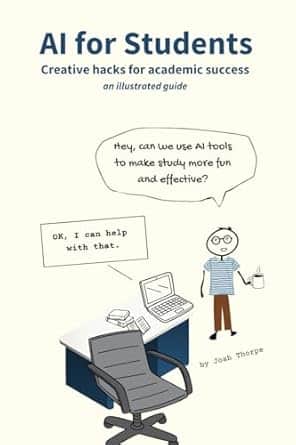
This is a contributed post by Josh Thorpe, the author of AI for Students, a comic-style book that teaches students and educators many ways to use AI in effective and healthy ways, without cheating.

Studies show that up to 70% of high school students have experimented with artificial intelligence tools such as ChatGPT, Google Gemini, Copilot, and others. It seems that over 50% have used AI-powered chatbots to assist with schoolwork.
Is this a good thing? It can be, if it’s done well and with some guidance.
Ignoring or banning AI tools is one approach, but I’d argue that if we teach AI literacy instead, parents and teachers can guide students toward using AI tools in both productive and healthy ways. Students will see they don’t need to use the technology to cheat or outsource their minds. In fact, they’ll see that these tools can actually help them enjoy learning and think more deeply and critically.
When ChatGPT first appeared on the internet, many parents and educators were rightly concerned, and remain so. Will students effectively plagiarize their work, cheating themselves out of the learning process and miss the opportunity to build knowledge and learn to solve problems? Will students lose their drive or their thirst for learning once they see that instant answers are just a click away? Will AI tools make our culture lazy and helpless?
Related: 8 Tips to Help Your Teen Communicate More Effectively in Today’s Digital World
These concerns are entirely understandable, and I share them. But as an academic advisor in higher education, I have seen that students will use this technology regardless of educators’ worries. So earlier this year I decided to embrace AI more fully myself, using the technology daily and even writing a book on the topic.
The experience has taught me how to use AI tools in ways that are both immediately gratifying, and compatible with good learning and academic practice. In fact, I think I’ve found a way to use AI that’s both good for the brain and more fun.
3 Principles to Making AI Effective for Students
1. Human intelligence comes first.
AI is a tool that should support students, not replace their thinking. To this end, we should keep students at the center of the learning process rather than on the edge looking in. So, instead of viewing AI as just a content generator, or a genie in a bottle, we must show our kids how to use it to spark their own magic and creativity. The goal is to use AI to activate the mind, not substitute for it. We can model this.
If you’ve ever played around with tools such as ChatGPT, maybe you’ve asked it to write you a poem or a song. I have, and I found the results amusing at first, but ultimately no replacement for a human poet or songwriter.
Instead, try writing a poem yourself and get ChatGPT to critique it. See what happens—I suspect you’ll have more fun, create something better, and learn something in the process.
2. Treat AI as a virtual classroom.
AI should be seen not as a simple tool, but rather an interactive, digital environment. In this way, students learn to use AI platforms as resources to help them remember and apply vocabulary and ideas, and even as a space for thinking creatively and using ideas that are tricky to master.
For example, rather than asking a chatbot something like “What is the first amendment?” students can instruct the chatbot to quiz them. This will give the student the opportunity to put effort into recalling and using ideas they’re supposed to be learning themselves.
When I wanted to understand different perspectives on morality recently, I asked the chatbot to push me to explain and provide examples. I got immediate feedback on my answers and opportunities to make arguments about what I thought of each perspective. The result is that I’m clearer on my own view of the topic, yet more accepting of others’ views.
3. Master “prompt” design for active learning.
Prompts are the inputs you give to the AI. They matter. Writing thoughtful, precise prompts can lead to much richer learning experiences. Learning creative prompt design is fun and straightforward. It just means getting in the habit of instructing the AI tool as to a) what your aim is, b) what role the bot should play, and c) what format the outputs should come in.
For instance, a student might tell the AI, “I need to understand democracy better and be able to identify what makes or breaks democratic norms in real societies. Quiz me using real examples, give hints as to how I can improve my answer, and ask follow-up questions to make me say more. Thirty words maximum.”
In this way, the student crafts an entire learning experience that avoids easy answers and will keep them actively engaged for some time.
AI Literacy Can Lead to Better Learning
The advantages of the above approach seem clear: It promotes active recall, gives opportunities for the application of ideas, and motivates students to use their own mind rather than relying on the technology alone.
Importantly, as I’ve mentioned above, this approach is also more fun.
Before you jump straight in, however, it is important to note some cautions. All of this works best hand-in-hand with a critical view. AI literacy means reflecting on the unintended impacts the technology may have. For example, understanding the technology’s business model and its terms of use, as well as public concerns around intellectual property and sustainability.
Related: 10 of the Best Homework Apps For Teens To Help Them Succeed In School
Finally, simply from a practical perspective, the tools are not always correct. They get things wrong. Students need to understand this and begin to observe it for themselves in their interactions. With the approach I describe above, however, treating an AI chatbot as a peer tutor or study buddy allows users to more easily navigate any weakness of the system as they use it while completing assignments. In fact, the weakness becomes a strength in that it encourages the student to think for themselves.
So, let’s encourage real AI literacy in teenagers. By focusing on the learner and their experience and using active learning and good prompt design techniques, together we can support our young people to deepen their understanding, enhance their critical thinking, and become more engaged with learning altogether.
For more on developing AI literacy for teens, parents, and educators, we recommend AI
for Students.
Parenting teens and tweens is a tough job, but you’re not alone. These posts might help:
Parenting in the Influencer Age of Toxic Social Media
Mental Health Issues Stopped My Son From Graduating High School On Time
10 Valuable Lessons My Teens Taught Me About Parenthood
*This post contains affiliate links where we earn a small commission for sales made from our website.